
The Big Biodiversity Challenge is back – Learners Tackle Biodiversity Crisis in Provincial Competition
The Western Cape Environmental Education Friends (WCEEF), together with members CapeNature, SANBI, Nature Connect, SANParks, Working on Fire, the City of Cape Town, The Environmental Education Association of Southern Africa (EEASA) and the Two Oceans Aquarium, is thrilled to announce the return of its successful competition for children in grades 6 – 9.
The Big Biodiversity Challenge was launched during May, which is especially fitting, as the month is widely recognised as Biodiversity Month – a time dedicated to raising awareness and action for the protection of our natural world. With the International Day for Biological Diversity falling on 22 May, the timing of the competition aligns perfectly with global efforts to spotlight the annual theme for 2025, “Harmony with Nature and Sustainable Development”. This year’s theme emphasises the urgent need to align human progress with the protection and restoration of the natural world. It highlights a call to action for all stakeholders to make choices that benefit both people and the environment, building a future where both can thrive together. The competition closes on July 31st so Apply Now!
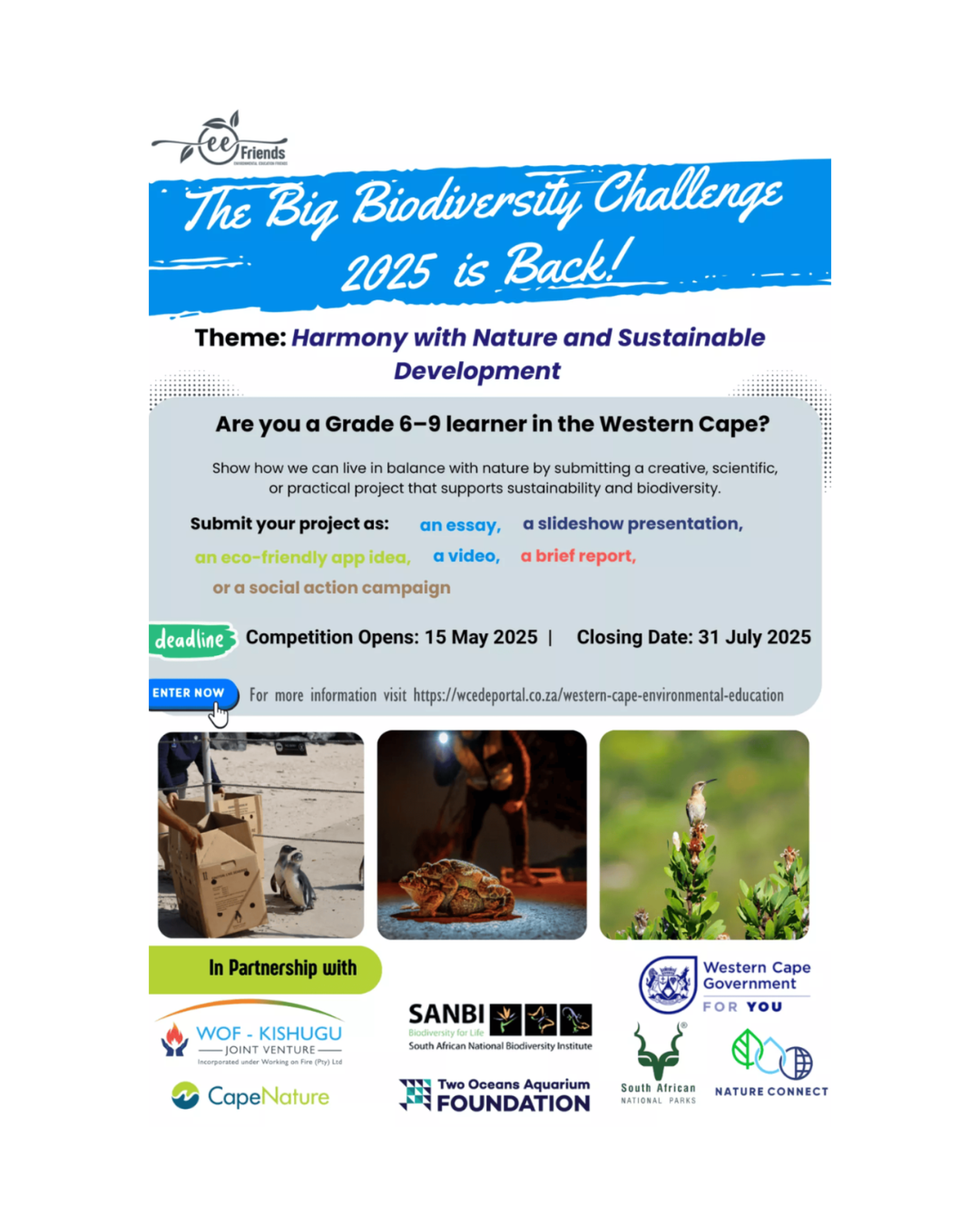
The competition calls on students to submit projects that offer solutions to any of the many threats facing biodiversity. These solutions can take the form of a scientific project, creative arts project or social project. The goal is to encourage critical thinking and creativity in addressing issues such as the unsustainable use of natural resources, climate change and habitat loss – challenges that directly impact the health of our ecosystems. The theme encourages entrants to explore practical, nature-based solutions that support both environmental protection and human well-being.
The competition is open to all schools in the Western Cape and submissions can be made individually or in pairs. Participants will have the chance to win exciting prizes. Winners will be announced at the 43rd annual EEASA Conference, which will take place between 16 and 19 September this year.
As the implementing agent of the WCEEF, we are excited to join forces with the incredible and diverse members of this forum in bringing this competition to the learners of the Western Cape. What makes it even more special this year is the unique opportunity for these young champions to showcase their work on an international stage, and that kind of exposure is not only inspiring, but life changing.
All students in grade 6 – 9 are encouraged to participate and it is recommended that teachers motivate their students to enter this competition and become part of the movement to protect biodiversity. For more information email Munzhedzi.Muhanelwa@sanparks.org or ndreyer@capenature.co.za
Related News

WESSA recognises 62 Blue Flags and 19 Green Coast sites as South Africa marks 25 years of coastal stewardship
South Africa’s Blue Flag and Green Coast programmes are entering their next chapter with a renewed focus on environmental stewardship, inclusion, community participation and long-term coastal resilience, as WESSA, the Wildlife and Environment Society of South Africa, celebrates 25 years of Blue Flag in South Africa and its own centenary.

CapeNature visitors invited to support communities through new donation scheme
A visit to a CapeNature nature reserve can help a neighbour in need. From 5 October 2026, guests at three participating nature reserves can bring gently used clothing, blankets and other essential items for local non-profit organisations. The first phase of the donation scheme will run at Grootvadersbosch Nature Reserve near Heidelberg, Kogelberg Nature Reserve near Kleinmond, and Cederberg Wilderness Nature Reserve near Clanwilliam.

Radio network upgrade to strengthen emergency communication in Hangklip area
CapeNature and Overstrand Municipality will install a small radio repeater station near Hangklip Peak as part of an upgrade to the region’s radio communication network. The repeater will strengthen the communication networks used by both parties and improve coverage across the Overstrand municipal area, Kogelberg Nature Reserve, Betty’s Bay Marine Protected Area and parts of the City of Cape Town. Reliable radio communication is essential for the daily operations of

State of Conservation Report 2026 tracks progress and pressures facing Western Cape biodiversity
The Western Cape’s biodiversity is facing mounting pressure, with a sharp increase in the area affected by fires and more ecosystems and species classified as threatened, according to the Western Cape State of Conservation Report 2026. The report records 107 fires that burned 215 936 hectares during the 2025/26 reporting period – almost three times the 75 174 hectares burned by 97 fires in the previous reporting period.

El Niño raises fire risk as Western Cape prepares for a challenging fire season
The Western Cape is preparing for a potentially challenging wildfire season, with the developing El Niño weather pattern expected to contribute to hotter and drier conditions and an increased risk of wildfires across the province. The South African Weather Service has warned of below-normal rainfall associated with the expected strong El Niño during the coming summer season. While El Niño does not automatically mean that every part of the province will experience drought

Cape fur seal safety remains important this World Rabies Day
On World Rabies Day (28 September), CapeNature is reminding residents and visitors to keep a safe distance from Cape fur seals and to act immediately if they or their pets are bitten, scratched or exposed to a seal’s saliva. Rabies has been detected in Cape fur seals along the South African coastline and by the end of 2025, at least 176 people had been bitten by seals. While most seals do not pose a threat to people, they are wild animals and should never be approached, touched, fed or encouraged to interact with humans.