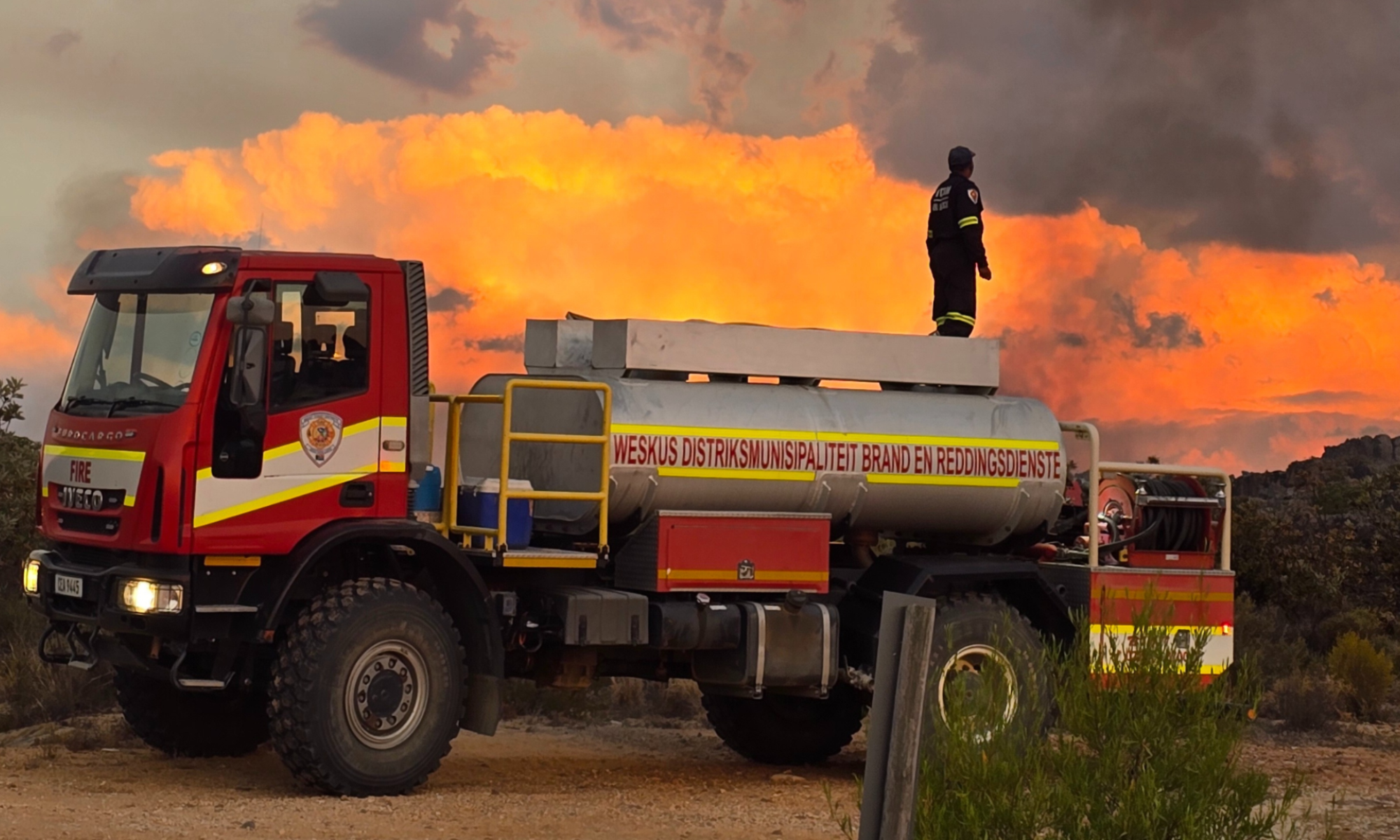
Cederberg Complex Fire Update
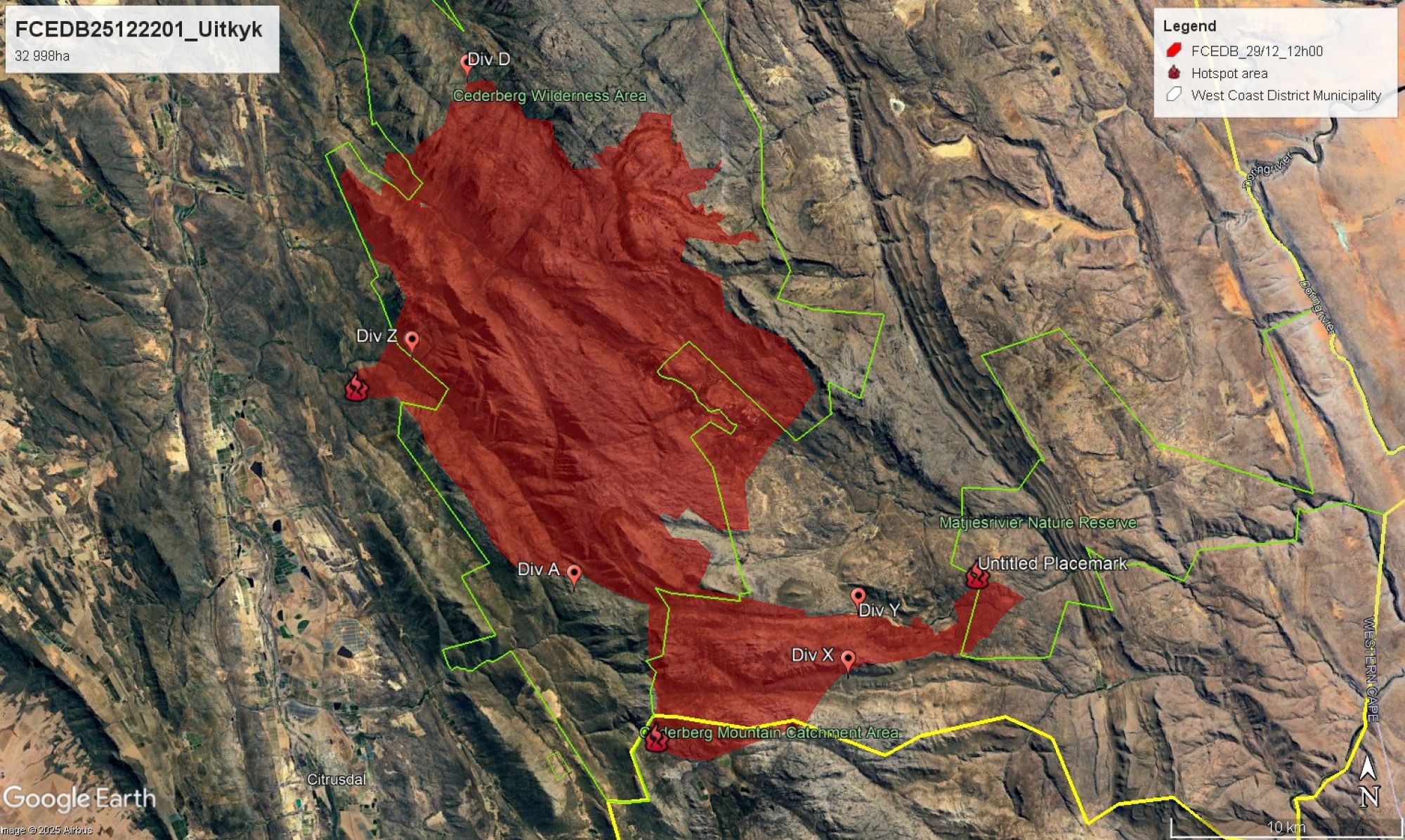
The wildfire in the Cederberg, which started on 22 December, continues to be actively managed by firefighting agencies. The affected area is now measured at just over 34 000 hectares. While large sections of the fire are contained, the fire is not yet fully contained, and multiple active fire lines remain, particularly in mountainous and inaccessible terrain.
The fire has moved through Algeria, Driehoek, Kromrivier, Stadsaal and Truitjieskraal. Importantly, no lives have been lost, and no houses have been destroyed. Property damage has been limited to a wooden cottage and a caravan at Driehoek. At present, no structures are under immediate threat.
This past week has been exceptionally demanding and has once again highlighted the remarkable co-operation and resilience shown by firefighting agencies, local communities and neighbours working together under challenging conditions.
Ground firefighting resources remain deployed between Kromrivier, Gonnafontein, Stadsaal and Truitjieskraal, where teams are actively monitoring and safeguarding properties in the Eastern Cederberg.
Active firefighting continues around Maraisberg and between Citrusdal and Niewoudtspas, with multiple ground teams deployed. Tactics include direct firefighting, monitoring, and strategic burn-outs along firebreaks and jeep tracks to prevent further spread.
Resource coordination is being led by CapeNature, West Coast District Municipality, and the Greater Cederberg Fire Protection Association, with support from Working on Fire (WOF) and Volunteer Wildfire Services (VWS). As the fire edge has moved, the Cape Winelands District Municipality joined operations today as the fire enters their jurisdiction.
What this fire has again clearly demonstrated—and must be reiterated with landowners—is the critical importance of well-maintained access roads and firebreaks. Cleared defensible space around homes is essential, as dense vegetation, large trees and bushes close to structures pose the greatest risk, particularly when fires spot or jump into thick fuel loads around buildings.
Visitor Access and Closures
Visitors wishing to access the Cederberg are advised that all CapeNature-managed properties are currently closed. This includes:
- All hiking trails
- Algeria and Bosherberge Campsites
- Stadsaal
- Truitjieskraal
The following private properties are also closed:
- Driehoek
- Kromrivier – Cederberg Park (temporarily closed)
Sites that remain open include:
- Sandrif
- Wolfberg Cracks
- Oasis
- Nuwerus
CapeNature requests members of the public and social media users not to share outdated images, misinformation or unverified reports, as this creates unnecessary panic. Much of the area burnt consists of old fynbos veld, which is a fire-adapted ecosystem, and we anticipate healthy regeneration following good winter rains.
CapeNature extends sincere thanks to everyone who has supported firefighting teams, including donations of refreshments, which are greatly appreciated and help sustain crews in the field.
Further updates will follow this evening.
Related News

Penguin Palooza 2026 returns to Stony Point in support of African Penguin conservation
Stony Point in Betty’s Bay is one of the last known locations on Earth where African Penguins still breed on the mainland, and the species is under growing pressure. On Saturday, 7 November 2026, Penguin Palooza returns to Stony Point Nature Reserve, giving the public a chance to learn about the species and the work CapeNature, SANCCOB and other partners are doing to protect it.

Robberg Nature Reserve named Best Outdoor Activity in 2026 Readers’ Choice Awards
Robberg Nature Reserve named Best Outdoor Activity in 2026 Readers’ Choice Awards. Robberg Nature Reserve has been named the Best Outdoor Activity in the Best of Knysna & Plett Readers’ Choice Awards 2026. The recognition follows months of nominations and voting by communities across Knysna, Plettenberg Bay and Sedgefield, making the award a meaningful reflection of the place Robberg holds in the local community.

CapeNature maintains clean audit record and expands the Western Cape’s Protected Areas
CapeNature's 2025/26 Annual Report shows the Entity added more than 44 000 hectares to the Western Cape conservation estate over the year. The additions extend protection across mountain catchments that feed the province's water supply, guarding them against the invasive plant growth and wildfire risk that threaten water security. Ultimately the protected areas expansion improves our ability to conserve the rich and unique Western Cape biodiversity.

WESSA recognises 62 Blue Flags and 19 Green Coast sites as South Africa marks 25 years of coastal stewardship
South Africa’s Blue Flag and Green Coast programmes are entering their next chapter with a renewed focus on environmental stewardship, inclusion, community participation and long-term coastal resilience, as WESSA, the Wildlife and Environment Society of South Africa, celebrates 25 years of Blue Flag in South Africa and its own centenary.

CapeNature visitors invited to support communities through new donation scheme
A visit to a CapeNature nature reserve can help a neighbour in need. From 5 October 2026, guests at three participating nature reserves can bring gently used clothing, blankets and other essential items for local non-profit organisations. The first phase of the donation scheme will run at Grootvadersbosch Nature Reserve near Heidelberg, Kogelberg Nature Reserve near Kleinmond, and Cederberg Wilderness Nature Reserve near Clanwilliam.

Radio network upgrade to strengthen emergency communication in Hangklip area
CapeNature and Overstrand Municipality will install a small radio repeater station near Hangklip Peak as part of an upgrade to the region’s radio communication network. The repeater will strengthen the communication networks used by both parties and improve coverage across the Overstrand municipal area, Kogelberg Nature Reserve, Betty’s Bay Marine Protected Area and parts of the City of Cape Town. Reliable radio communication is essential for the daily operations of