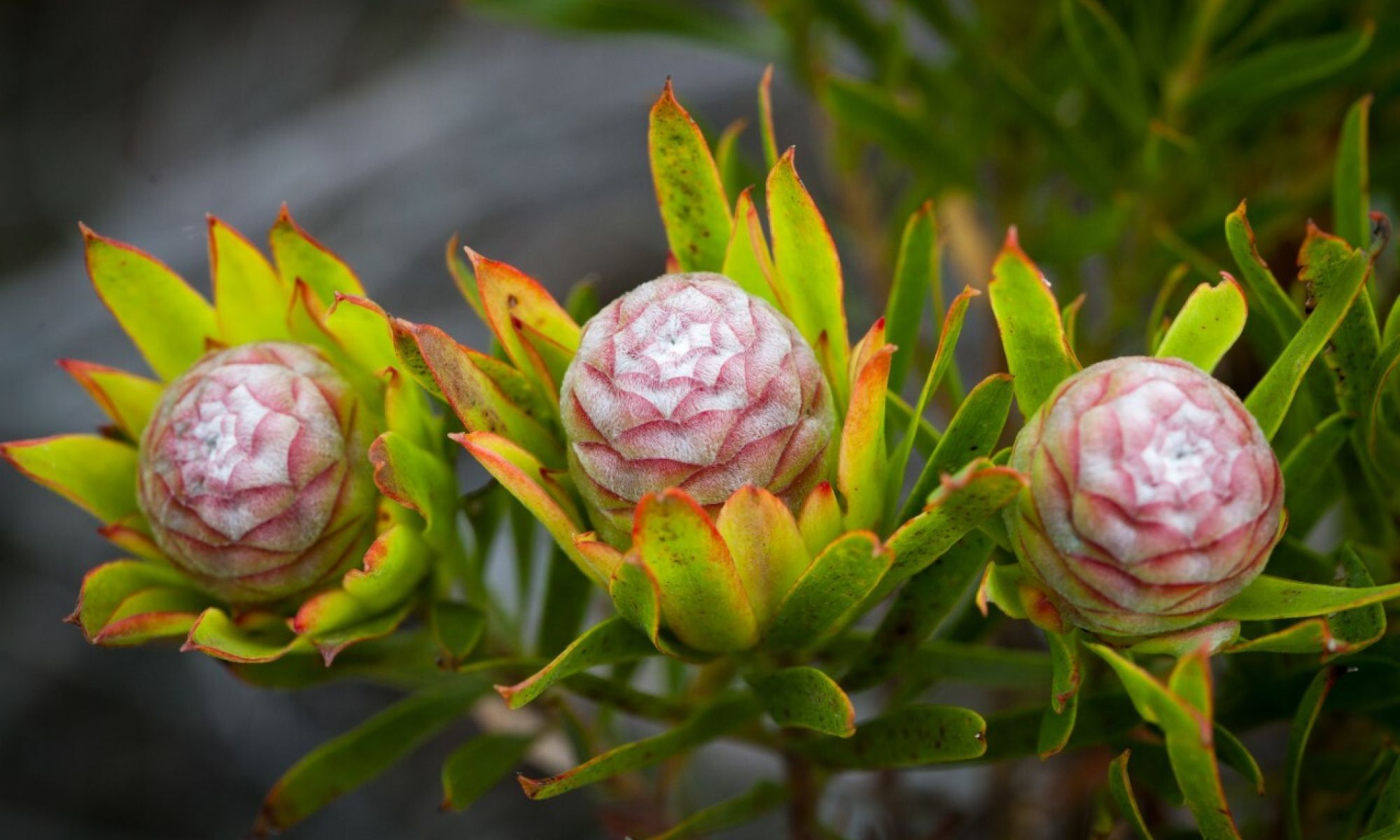
The spectacular Proteaceae family
Residents of the Western Cape are privileged to live amongst such floral beauty. Nature reserves managed by CapeNature offer numerous opportunities to experience the exceptional biodiversity of this biodiversity hotspot region we call home. Many species of the iconic Proteaceae family are flowering right now.
The family Proteaceae was named in 1767 by Carl Linnaeus after Proteus, one of the gods in Greek mythology who had the ability to constantly change his form. The name Proteaceae and Protea thus echo the variability of many different plant forms found within the large family. The Proteaceae is one of the most spectacular plant families in South Africa. The first record of any plant ever described in southern Africa was Protea neriifolia, described by Clusius, 50 years before Jan van Riebeeck landed at the Cape of Good Hope (Vogts 1960).
The Core Cape Subregion of South Africa (also referred to as the Greater Cape Floristic Region) is one of the world’s most remarkable hotspots of biodiversity. The region comprises an estimated 9 400 species of vascular plants of which almost 70% are endemic. It is home to six endemic or near-endemic families, of which the Proteaceae is one of the most well-known.
Fourteen genera of the Proteaceae occur in southern Africa, namely Aulax
(featherbushes - 3 taxa), Brabejum (Wild Almond being the single taxon), Diastella (silkypuffs - 9 taxa), Faurea (beechwoods - 5 taxa), Leucadendron
(conebushes - 98 taxa), Leucospermum (pincushions – 54 taxa), Mimetes
(pagodas – 13 taxa), Orothamnus (Marsh Rose being the single taxon), Paranomus
(sceptres - 19 taxa), Protea (sugarbushes – 87 taxa), Serruria (spiderheads – 59 taxa), Sorocephalus (clusterheads - 11 taxa), Spatalla (spoons - 20 taxa), and Vexatorella (vexators - 5 taxa) (Rebelo 1995; SANBI 2020). Two genera are dioecious, namely Aulax and Leucadendron (Figure 1). Growth forms in the Proteaceae differ vastly, from prostrate shrubs (Figure 2) to tall trees. All species have compound flower heads, called inflorescence.

Figure 1: Leucadendron sp. photo by Scott Ramsay

Figure 2: Leucospermum prostratum photo by Steve Gildenhuys)
Pollination of Proteas
Most species of Proteaceae are pollinated by birds, e.g., the national flower which is the King Protea (Protea cynaroides), the common and well-known sugarbush (P. repens), and most of the bearded Proteas (P. neriifolia, P. laurifolia, P. magnifica, P. lorifolia). Bird pollinated species mostly have brightly coloured involucral bracts to attract birds of which the most important are the sugarbirds and sunbirds (Figure 3). Several species are pollinated by rodents, including gerbils, mice, rats and shrews. An interesting fact is the one species, P. punctata (Figure 4), which has implemented a pollination shift to being pollinated primarily by long-proboscid flies and butterflies (Johnson et al. 2012). Another interesting species is Leucospermum arenarium which is listed as Critically Endangered. This species depends on rodents for pollination and presents its viscous nectar in an exposed position on petal tips to allow rodents easy access without destroying the inflorescences (Johnson & Pauw 2014). Some species are pollinated by bees, e.g., Diastella thymelaeoides ssp. meridiana (Figure 5). The inflorescences of bee-pollinated species are considerably smaller in size than those of bird-pollinated species. There are also 10 wind-pollinated members of the Proteaceae in southern Africa, all of which are Leucadendron species. These species are odourless and do not secrete nectar.
Figure 3: Protea eximia photo by capietours at iNaturalist

Figure 4: Protea punctata photo by Charleen Brunke

Figure 5: Diastella thymelaeoides ssp. meridiana photo by Ruida Pool-Stanvliet
Some species of Proteaceae exude a ‘yeasty’ scent, which is a typical trait of plants pollinated by small mammals (Kühn et al. 2017). Visits by small mammals do not however preclude visits by other pollinators, such as sunbirds and insects. The mammal-pollinated flowers are more open-shaped and with a diameter wider than the length of the inflorescence, e.g., Protea canaliculata, P. sulphurea, and P. humiflora.
CapeNature Reserves and flowering Proteaceae
Some of the winter-flowering (June to August) Proteaceae observable in CapeNature reserves are Mimetes cucullatus (widespread common pagoda, Figure 6), Protea nitida (widespread waboom, Figure 7), Protea coronata (green sugarbush, Garden Route), Protea sulphurea (sulphur sugarbush, Hexrivier, Swartberg), Protea magnifica (bearded sugarbush, Hottentots Holland, Langeberg, Outeniqua, Kammanassie), Protea laurifolia (grey-leaf sugarbush, Hottentots Holland, Riviersondered, Anysberg), Spatalla barbigera (fine-leaf spoon) and Leucospermum royenifolium (eastern pincushion, both Outeniqua and Swartberg mountains), Leucospermum prostratum (yellow-trailing pincushion, Kogelberg, Figure 2), Paranomus dregei (scented sceptre, Anysberg and Swartberg), and Paranomus bolusii (Overberg sceptre, Groenlandberg).

Figure 6: Mimetes cucullatus photo by Scott Ramsay

Figure 7: Protea nitida photo by pleistocene from iNaturalist
Figure 1: Leucadendron sp. (Image: Scott Ramsay)
Figure 2: Leucospermum prostratum (Image: Steve Gildenhuys)
Figure 3: Protea eximia [Acknowledgement: iNaturalist © capietours (CC BY-NC 4.0)]
Figure 4: Protea punctata (Image: Charleen Brunke)
Figure 5: Diastella thymelaeoides ssp. meridiana (Image: Ruida Pool-Stanvliet)
Figure 6: Mimetes cucullatus (Image: Scott Ramsay)
Figure 7: Protea nitida [Acknowledgement: iNaturalist © pleistocene (CC BY-NC 4.0)]
References:
Johnson, C.M. & Pauw, A. 2014. Adaptation for rodent pollination in Leucospermum arenarium (Proteaceae) despite rapid pollen loss during grooming. Annals of Botany 113: 931–938.
Johnson, S.D., Newman, E. & Anderson, B. 2012. Preliminary observations of insect pollination in Protea punctata (Proteaceae). South African Journal of Botany 83: 63–67.
Kühn, N., Midgley J. & Steenhuisen, S.-L. 2017. Reproductive biology of three co-occurring, primarily small-mammal pollinated Protea species (Proteaceae). South African Journal of Botany 113: 337–345.
Rebelo, T. 1995. Proteas: A field guide to the Proteas of Southern Africa. Cape Town: Fernwood Press.
SANBI. 2020. Red List of South African Plants version 2020.1. Downloaded from Redlist.sanbi.org on 2022/05/18.
Vogts, M. 1960. The South African Proteaceae: the need for more research. South African Journal of Science, pp. 297-305. URL: https://journals.co.za/doi/pdf/10.10520/AJA00382353_4709
Related News

School holidays in nature sound like a plan, parents?
Make the most of the school holidays with unlimited adventures at up to 24 CapeNature reserves! Enjoy hiking, picnics, wildlife spotting, and more with a CapeNature Cluster Wild Card. Find out more: https://www.capenature.co.za/wild-card
#CapeNature #WildCard #SchoolHolidays

Marine Month: A Splashy Celebration for our Feathered Ocean Friends!
October isn’t just about spring flowers and sneaky sunburns — it’s Marine Month, the ocean is throwing a party, and you are invited!

Don’t be Trashy Drive
Hey, you — yes, YOU with the snack wrapper in your pocket! Are you ready to become a planet-saving, litter-busting superhero? Then it’s time to join the Don’t Be Trashy Drive — the most fun you’ll ever have while picking up other people’s mess!

Access Week Adventure: Nature’s Calling — Are You In?
Mark your calendars for Access Week, 19 – 25 September 2026 - a whole week when CapeNature reserves open their gates, FOR FREE, for you and your family!

Individual Action Projects - Climate Countdown
🌍💚 Here are some fun ways you can take climate action and help protect wildlife at the same time! Every small step helps slow climate change and keeps our natural spaces safe and healthy. 🐾🌿Just snap a picture of your action and send it to us—we’ll assign your points! 📸🏆 Simple, fun, and full of planet-saving power!

Group Action Projects - Climate Countdown
If you’re part of a Cubs Club group, your Climate Countdown mission is officially ON! ⏰🌍 Take on one (or more!) of these action projects and become a true planet protector in the fight against climate change. Every challenge helps protect wildlife, care for habitats, and keep our amazing natural spaces in the Western Cape healthy and thriving 🐾💚