
The Big Biodiversity Challenge Returns to Inspire Young Eco-Champions
The Western Cape Environmental Education Friends (WCEEF), together with members CapeNature, Western Cape Government, SANBI, Department of Forestry, Fisheries and the Environment (DFFE), Nature Connect, SANParks, Working on Fire, the City of Cape Town and the Two Oceans Aquarium Foundation, announces the return of its flagship biodiversity competition for learners in grades 6 – 9.
The Big Biodiversity Challenge launches in May, aligning with Biodiversity Month – a global call to raise awareness and inspire action to protect our natural world. With the International Day for Biological Diversity marked on the 22 May, the competition’s timing reinforces the 2026 theme, “Acting Locally for Global Impact.”
The theme underscores how small, community-driven actions can drive meaningful global change and calls on all stakeholders to contribute to local initiatives that support a healthy, sustainable environment where people and nature can thrive together.
The competition invites learners to submit innovative action-based projects that address the diverse threats facing biodiversity by not only proposing solutions, but also trying, testing, or putting their ideas into practice. Entries may take the form of scientific investigations, creative arts pieces, or social initiatives. Through this approach, the challenge aims to inspire critical thinking and creativity in tackling issues such as the unsustainable use of natural resources, climate change, and habitat loss—key pressures on ecosystem health. Participants are encouraged to develop practical, nature-based solutions that advance environmental protection while supporting human wellbeing, and to demonstrate how their ideas have been put into action, tested, or applied in response to a real biodiversity challenge. This is a chance for learners to step up, share bold ideas, and show how young voices can shape real solutions for the future of our planet.
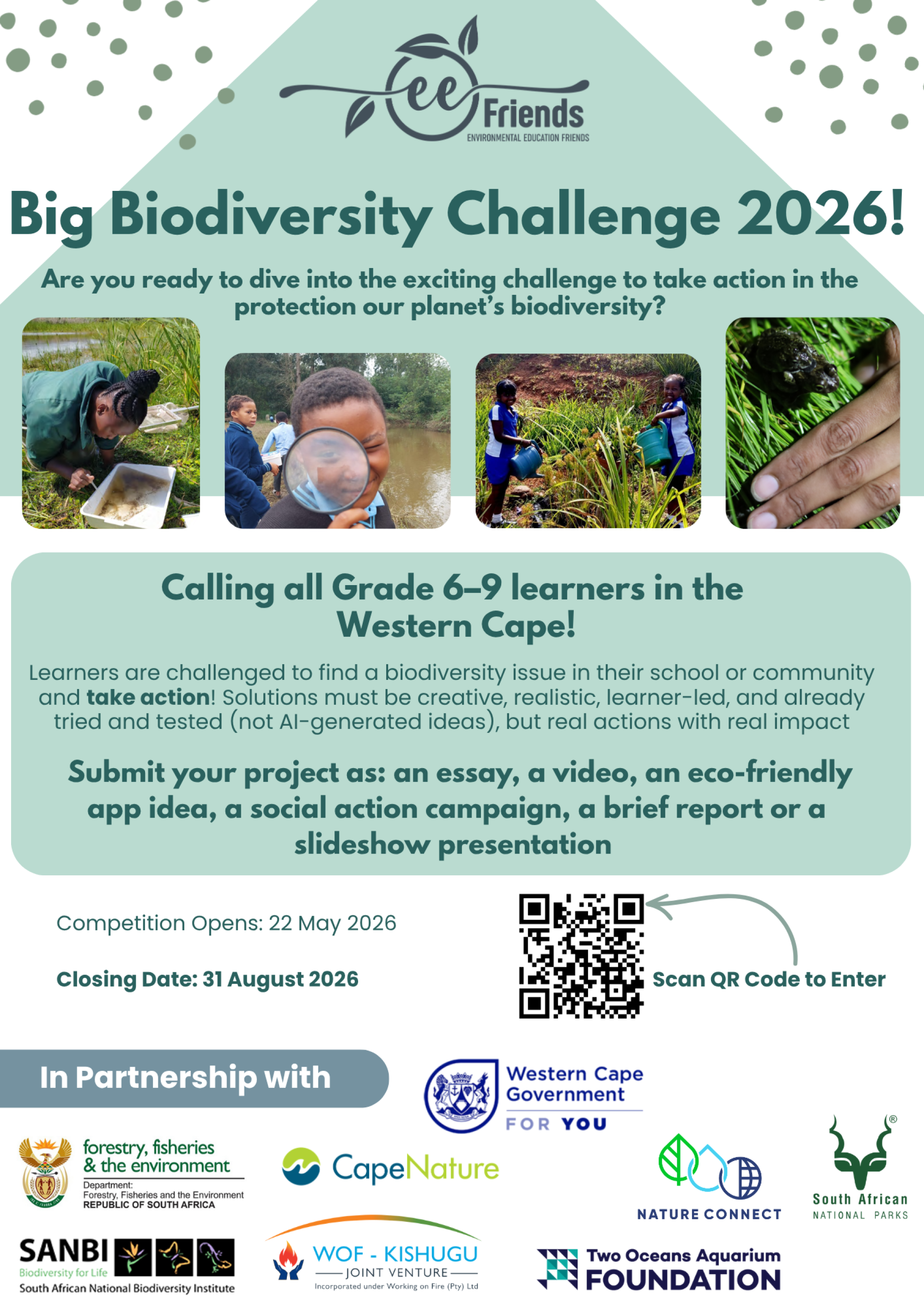
The competition is open to all schools in the Western Cape, and entries may be submitted either individually or in groups. Participants will have the opportunity to win a range of exciting prizes, including Working on Fire T-shirts, DFFE water bottles and USB sticks, a CapeNature educational outing to Stony Point, and a Table Mountain National Park environmental education experience at Boulders and Cape Point, including a cable car ride. Additional prizes include a class visit to the Two Oceans Aquarium with an educational lesson, as well as an outreach environmental education visit.
Building on South Africa’s role as host of the first Global Flagship Event for the International Day for Biological Diversity 2026, the Big Biodiversity Challenge calls on young people to turn local ideas into real-world environmental impact. This is a chance for learners to think boldly, get creative, and design practical solutions to environmental challenges while helping to protect South Africa’s extraordinary environment for generations to come.
All students in grade 6 – 9 are encouraged to participate and it is recommended that teachers motivate their students to enter this competition and become part of the movement to protect biodiversity. For more information email Munzhedzi.Muhanelwa@sanparks.org or ndreyer@capenature.co.za.
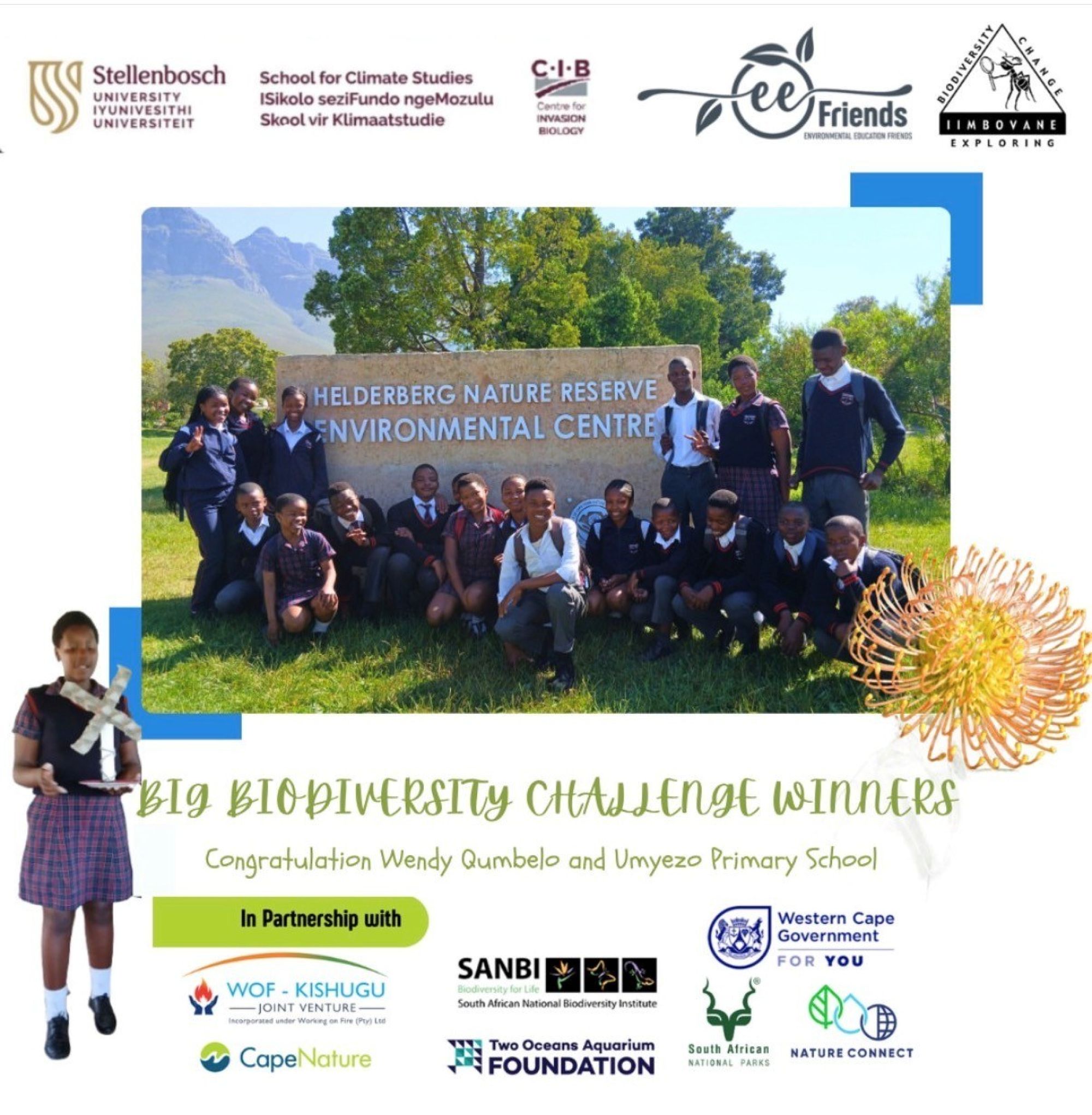
The Big Biodiversity Challenge 2025 Winners.
ABOUT Western Cape Environmental Education Forum (WCEEF)
The WCEEF is a platform for environmental education practitioners in the Western Cape who share the vision of providing education and resources on a wide range of subjects relating to nature conservation, the protection of the environment and sustainable development practices. It is also responsible for the overall co-ordination and optimisation of the environmental education activities in the Western Cape. The platform advocates for, and is informed by, the United Nations Global Education for Sustainable Development (ESD) 2030 Roadmap & 2030 Agenda.
ABOUT Western Cape Government (WCG)
The WCG through the Department of Environmental Affairs & Development Planning (DEA&DP), aims to preserve the environment for current and future generations by preventing environmental harm. This is achieved by making informed decisions (based on South African environmental legislation) and understanding how other legislation impacts these decisions to enabling a Resilient, Sustainable, Quality and Inclusive Living Environment.
ABOUT SANParks
South African National Parks (SANParks) is the leading conservation authority which conserves South Africa’s rich diversity of fauna and flora through the protection of 21 National parks across the country. Established in 1926, SANParks’ mission is to conserve, expand and sustainably manage our countries natural and cultural assets for the wellbeing of present and future generations. Through its Environmental Education and Awareness programmes, SANParks promotes environmental ethics by enhancing understanding and awareness of environmental issues. Guided by its vision of creating “a future where people and nature thrive together in mega living landscapes”, SANParks seeks to re-imagine and co-create a new future for conservation in and through national protected areas.
ABOUT Nature Connect
Nature Connect’s mission is to support South Africa in achieving its sustainability goals by building an environmentally-empowered citizenry. Through Nature Connect’s Crèche-to-Career Model, a variety of programmes have been initiated to serve this mission and to build resilience within our communities and natural areas. The Crèche-to-Career Model addresses both the social and environmental challenges and is built across three phases: Education, Training and Employment.
ABOUT SANBI
The South African National Biodiversity Institute (SANBI) contributes to South Africa’s sustainable development by facilitating access to biodiversity data, generating information and
knowledge, building capacity, providing policy advice, as well as showcasing and conserving biodiversity in its national botanical and zoological gardens.
ABOUT The Department of Forestry, Fisheries and the Environment (DFFE)
The Department of Forestry, Fisheries and the Environment (DFFE) is mandated to manage, protect and conserve South Africa’s environment and natural resources in line with Section 24 of the Constitution. Through environmental legislation, policy development, awareness raising, capacity building and strategic partnerships, the Department promotes sustainable development and sound environmental management practices for the benefit of present and future generations. The DFFE also plays a key role in strengthening environmental stewardship and supporting collective action to address local and global environmental challenges.
ABOUT Two Oceans Aquarium Foundation
The southern tip of the African continent is the meeting place of two mighty and bountiful oceans, the Indian and the Atlantic. The Two Oceans Aquarium, situated in Cape Town’s V&A Waterfront, is ideally positioned to showcase the incredible diversity of marine life found in these two oceans.
ABOUT CapeNature
CapeNature is a public institution mandated to promote and ensure biodiversity conservation within the Western Cape and is the custodian of the Cape Floristic Region. The Entity manages most of the mountain catchments and reserves that supply ecosystem services to the citizens of the Western Cape. This requires good scientific data, a sound understanding of Fynbos ecology and commitment to the principles of integrated biodiversity management and planning. Most of this work is in remote areas out of the public eye but has a direct bearing on the quality of life of millions of people in the province.
ABOUT Working on Fire (WOF)
The Fire Awareness & Fire Safe Programme is a cornerstone of the Working on Fire (WoF) Programme, combining environmental education with practical, science-based tools to promote fire and life safety. It empowers communities with disaster risk assessment and mitigation strategies, fostering responsible fire behaviour and strengthening resilience to the impacts of climate change.
The Fire Awareness in Schools Project shapes future environmental leaders by teaching learners the essentials of wildfire prevention, fire safety, and climate resilience. Aligned with South Africa’s National Curriculum, the programme delivers practical, science-based knowledge through interactive lessons, hands-on activities, and real-life insights from trained firefighters.
ABOUT City of Cape Town
The City of Cape Town Metropolitan Municipality forms the local government of Cape Town. Cape Town is one of the most biodiverse cities in the world. This biodiversity is unique and irreplaceable, and conserving and managing these natural open spaces is critical to ensure Cape Town is sustainable into the future. The City is committed to integrating nature and biodiversity into urban planning and sustainability efforts, protecting and enhancing natural assets and biodiversity while supporting economic growth and urban development. Through their spatial planning and City strategies, they strive to create a resilient and sustainable urban environment that balances biodiversity conservation with the needs of a growing and dynamic city.
MEDIA ENQUIRIES:
CapeNature
Communications Officer
Luke Folb
lfolb@capenature.co.za
071 432 7404
Related News

CapeNature maintains clean audit record and expands the Western Cape’s Protected Areas
CapeNature's 2025/26 Annual Report shows the Entity added more than 44 000 hectares to the Western Cape conservation estate over the year. The additions extend protection across mountain catchments that feed the province's water supply, guarding them against the invasive plant growth and wildfire risk that threaten water security. Ultimately the protected areas expansion improves our ability to conserve the rich and unique Western Cape biodiversity.

WESSA recognises 62 Blue Flags and 19 Green Coast sites as South Africa marks 25 years of coastal stewardship
South Africa’s Blue Flag and Green Coast programmes are entering their next chapter with a renewed focus on environmental stewardship, inclusion, community participation and long-term coastal resilience, as WESSA, the Wildlife and Environment Society of South Africa, celebrates 25 years of Blue Flag in South Africa and its own centenary.

CapeNature visitors invited to support communities through new donation scheme
A visit to a CapeNature nature reserve can help a neighbour in need. From 5 October 2026, guests at three participating nature reserves can bring gently used clothing, blankets and other essential items for local non-profit organisations. The first phase of the donation scheme will run at Grootvadersbosch Nature Reserve near Heidelberg, Kogelberg Nature Reserve near Kleinmond, and Cederberg Wilderness Nature Reserve near Clanwilliam.

Radio network upgrade to strengthen emergency communication in Hangklip area
CapeNature and Overstrand Municipality will install a small radio repeater station near Hangklip Peak as part of an upgrade to the region’s radio communication network. The repeater will strengthen the communication networks used by both parties and improve coverage across the Overstrand municipal area, Kogelberg Nature Reserve, Betty’s Bay Marine Protected Area and parts of the City of Cape Town. Reliable radio communication is essential for the daily operations of

State of Conservation Report 2026 tracks progress and pressures facing Western Cape biodiversity
The Western Cape’s biodiversity is facing mounting pressure, with a sharp increase in the area affected by fires and more ecosystems and species classified as threatened, according to the Western Cape State of Conservation Report 2026. The report records 107 fires that burned 215 936 hectares during the 2025/26 reporting period – almost three times the 75 174 hectares burned by 97 fires in the previous reporting period.

El Niño raises fire risk as Western Cape prepares for a challenging fire season
The Western Cape is preparing for a potentially challenging wildfire season, with the developing El Niño weather pattern expected to contribute to hotter and drier conditions and an increased risk of wildfires across the province. The South African Weather Service has warned of below-normal rainfall associated with the expected strong El Niño during the coming summer season. While El Niño does not automatically mean that every part of the province will experience drought