
Western Cape conservation efforts highlighted on World Biodiversity Day
Every year on 22 May, International Day for Biological Diversity (or World Biodiversity Day) is commemorated, and is meant to increase awareness about the many wonders of biodiversity, the numerous threats to it, and more importantly, what we can do to reduce or eliminate these threats.
It marks 34 years since the Convention on Biological Diversity (CDB) came into force and reinforces the pledge to implement the targets of the Kunming-Montreal Global Biodiversity Framework – a global agreement to halt and reverse biodiversity loss by 2030 through conservation, sustainable use, and ecosystem restoration targets.
This year’s theme, “Act locally, for Global impact”, is designed to hit home and demonstrate that a collection of small actions can have a significant global impact. This year will also be the first time that South Africa, or any member state of the United Nations Convention on Biological Diversity, will host a Global Flagship Event.
This puts the country front and centre in showcasing our biodiversity, highlighting issues facing biodiversity as well as what we are doing locally to address these issues. In the Western Cape alone, you can find enough diversity of species in the fynbos biome to rival that of some countries. This means that we have a huge role to play and an important responsibility in meeting global biodiversity targets.
Often when we think of biodiversity, we picture fields of green grass, shrubs, tall trees with grazing animals, and predators lurking in the shadows. We often overlook the multitudes of small invertebrates; the life under the soil, in the ponds and streams and everything too small for us to see. All these elements are interconnected and work together in their environment, not for the sole benefit of human beings, although we do reap the benefits nonetheless, but for survival and passing on their DNA to new offspring. These combined elements form the Ecological ‘machinery’ that provides us with food, clean air and water, healthy soils, pollination, energy as well as spiritual and economic value.
However, threats to biodiversity persist, with habitat destruction, overutilisation, pollution, climate change, invasive species and incorrect land use practices dominant. CapeNature and the Western Cape Government are committed in the fight to conserve and preserve biodiversity through various programmes and initiatives with the support of strategic partners and the public.
A good example is through the stewardship programme, where 25 new Nature Reserves were added with a total of 81 902 hectares of ecologically significant land, in the last financial year (April 2025 – March 2026) alone. This goes a long way to help meet the 30x30 Global Biodiversity Framework goal of protecting 30% of the planet’s land and water by the year 2030. The best part is that all these new reserves were possible by landowners who voluntarily committed to have their land formally declared as Protected Areas or nature reserves. This fits in perfectly with this year’s theme and demonstrates that biodiversity conservation is not the responsibility of only formal or government entities, but anyone can take part.
What you do may seem insignificant, but it is most important that you do it.
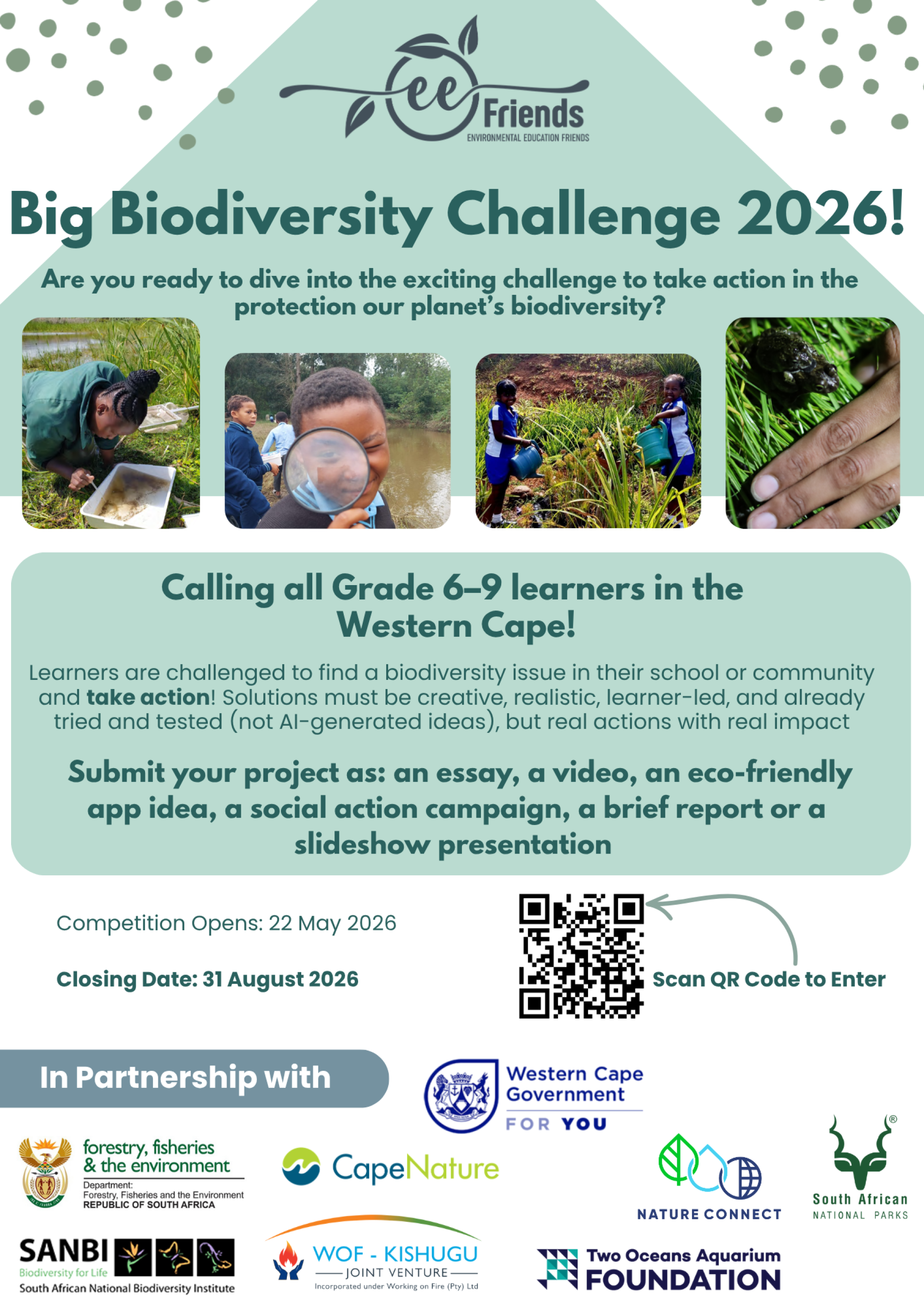
The Western Cape Environmental Education Friends (WCEEF), together with members CapeNature, Western Cape Government, SANBI, Department of Forestry, Fisheries and the Environment (DFFE), Nature Connect, SANParks, Working on Fire, the City of Cape Town and the Two Oceans Aquarium Foundation, announced the return of its flagship biodiversity competition for learners in grades 6 – 9.
The Big Biodiversity Challenge encourages learners to come up with innovative ways to tackle biodiversity issues through creative art, scientific investigations or social initiatives. This will also help raise an environmentally aware generation and helps to develop their skills and creative thinking as well.
The Western Cape Protected Areas Expansion Strategy, adopted in June 2025, is a vital informant for identifying a prioritised subset of biodiversity priority areas to be added to the network of Protected Areas that appropriately represents the biodiversity, ecosystems and ecological infrastructure of the Province.
There are several ways that one can support biodiversity conservation initiatives in their own areas. You can get your community involved through arranging clean-ups, awareness events, alien clearing initiatives or even through supporting your local Protected Area. At home, we could use less electricity or water, practice recycling and reduce waste, or just go for a hike and appreciate what nature provides. All these small actions can go a long way to impacting not only your immediate surroundings, but the whole planet as well.
Related News

Penguin Palooza 2026 returns to Stony Point in support of African Penguin conservation
Stony Point in Betty’s Bay is one of the last known locations on Earth where African Penguins still breed on the mainland, and the species is under growing pressure. On Saturday, 7 November 2026, Penguin Palooza returns to Stony Point Nature Reserve, giving the public a chance to learn about the species and the work CapeNature, SANCCOB and other partners are doing to protect it.

Robberg Nature Reserve named Best Outdoor Activity in 2026 Readers’ Choice Awards
Robberg Nature Reserve named Best Outdoor Activity in 2026 Readers’ Choice Awards. Robberg Nature Reserve has been named the Best Outdoor Activity in the Best of Knysna & Plett Readers’ Choice Awards 2026. The recognition follows months of nominations and voting by communities across Knysna, Plettenberg Bay and Sedgefield, making the award a meaningful reflection of the place Robberg holds in the local community.

CapeNature maintains clean audit record and expands the Western Cape’s Protected Areas
CapeNature's 2025/26 Annual Report shows the Entity added more than 44 000 hectares to the Western Cape conservation estate over the year. The additions extend protection across mountain catchments that feed the province's water supply, guarding them against the invasive plant growth and wildfire risk that threaten water security. Ultimately the protected areas expansion improves our ability to conserve the rich and unique Western Cape biodiversity.

WESSA recognises 62 Blue Flags and 19 Green Coast sites as South Africa marks 25 years of coastal stewardship
South Africa’s Blue Flag and Green Coast programmes are entering their next chapter with a renewed focus on environmental stewardship, inclusion, community participation and long-term coastal resilience, as WESSA, the Wildlife and Environment Society of South Africa, celebrates 25 years of Blue Flag in South Africa and its own centenary.

CapeNature visitors invited to support communities through new donation scheme
A visit to a CapeNature nature reserve can help a neighbour in need. From 5 October 2026, guests at three participating nature reserves can bring gently used clothing, blankets and other essential items for local non-profit organisations. The first phase of the donation scheme will run at Grootvadersbosch Nature Reserve near Heidelberg, Kogelberg Nature Reserve near Kleinmond, and Cederberg Wilderness Nature Reserve near Clanwilliam.

Radio network upgrade to strengthen emergency communication in Hangklip area
CapeNature and Overstrand Municipality will install a small radio repeater station near Hangklip Peak as part of an upgrade to the region’s radio communication network. The repeater will strengthen the communication networks used by both parties and improve coverage across the Overstrand municipal area, Kogelberg Nature Reserve, Betty’s Bay Marine Protected Area and parts of the City of Cape Town. Reliable radio communication is essential for the daily operations of